
Research and Invention for Architects

In my years as a full-time professor of architecture, I was involved in countless
faculty meetings that puzzled over what constituted “research” for architects, since research is what universities want to see for tenure cases. It has never been a mystery to me what research means for architects. At least since the Renaissance, architects have been involved with the study, and reconstruction, of ancient remains; one could also say more broadly they have reimagined what no longer
exists, or perhaps never existed. Measuring and documentation of ruins is perhaps overstressed,

since even Palladio relied as much on the drawings of his contemporaries as the actual measuring of Roman ruins. But reconstructions were where architects practiced their craft, so to speak, and places like the sanctuary of Palestrina furnished fodder for scholarly imagination from Bramante (whose Cortile del Belvedere at the Vatican owes not a little to the remains climbing the hill southeast of Rome) to Palladio to Pietro da Cortona. And the text of Vitruvius offered a variety of descriptions of lost or imaginary buildings and cities that architects would draw to reconstruct, again like Pietro da Cortona’s drawing of Dinocrates’ project for Mount Athos.
The reason to do reconstruction drawings was, though, not to propose rebuilding the ancient remains. It was to prove the architect’s mettle as a designer of new things, informed by the best of the past: a form of emulation in other words, “breaking a lance” as Longinus said of testing oneself against a formidable adversary. “This strife is good for mortals,” he says.

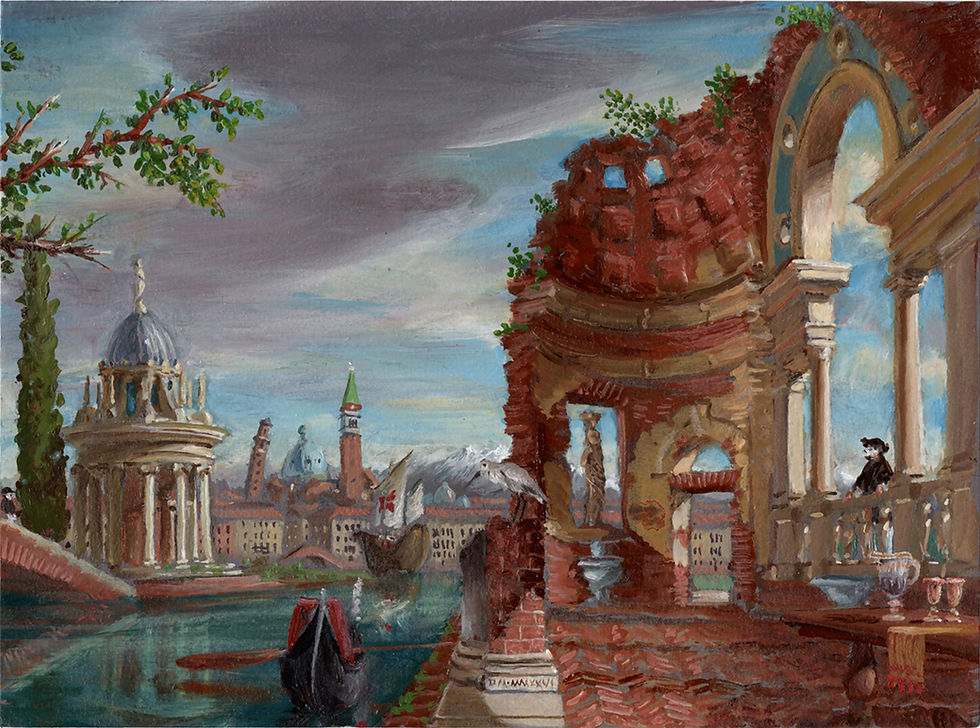
I proposed a reconstruction of the Renaissance ruins of what was probably a nymphaeum, outside Genazzano (a town just beyond Palestrina, if you’re coming from Rome); the scholarly article describing the reconstruction is open access on jstor. The ruins are evocative as they are, and I have no aversion to ruins per se—on the contrary, the 18th century was the great era of depicting ruins in paintings, especially as capricci. And the first half of the 18th century was also one of the most ebullient periods of architectural design. The love of ruins is not the ruin of love (as Léon Krier claimed in a Modulus article more than forty years ago).
I’ve been creating capricci for decades, lately with Venice as a subject: imaginary Venices. In sketching ideas for new capricci, I discovered the idea of combining the ruins from Genazzano with a lagoon landscape from my earlier views. If this is just a game, it’s a serious one, a serio ludere. Serious in the sense that it speculates (from the Latin speculat- ‘observed from a vantage point’) about both the ruins’ original watery context and the unstable nature of the Venetian lagoon.

Archaeology may be a science, and ars sine scientia nihil est; but reconstruction is an act of imagination, and neuroscience now recognizes how our memories are contaminated by imagination. If reconstruction requires scholarship to be credible, it’s most useful when it provides fodder for invention, or discovery, of other things: for “creativity.”
We are creative, people, after all. Architects should stop thinking they have to be pseudo-scientists or technocrats to be taken seriously. Our research is naturally in the realm of imagination, not tabulation. Filling the gaps of missing information is where we fit naturally, and most usefully. It’s how we have always learned, and gotten better. Our world does not lack for information, but for real imagination. Physics envy, as Denise Scott Brown called it, kills the art of architecture. Reviving it means being impractical, playful, and esoteric.


Comments